Survey software is usually described by how quickly it gets you to a deck. That is a fair thing to want. Hours spent on formatting, footers and rebuilt tables are hours not spent on the results.
But a deck is what you hand over. What a researcher is after is an answer to a question: what happened to consideration this wave, who is driving it, and whether the difference is worth a line in front of the client. A tool that only gets you to the deck sooner leaves that part where it was. At worst it lets you hand over the first version you saw.
We think the more useful aim is to make it cheap to look at the data in another way, and to see what a decision does before you make it. A faster report follows from that. It is not the reason for it.
#Thinking is done by looking at something and changing it
People do not work out most problems in their heads and then act. They act to find out. Kirsh and Maglio studied players of Tetris and found that they turn a falling piece to see whether it fits, because looking is quicker and more reliable than working it out in their heads.1 David Kirsh and Paul Maglio, "On Distinguishing Epistemic from Pragmatic Action", Cognitive Science 18(4), 1994, 513–549. They called these actions epistemic: made to learn something, not to get closer to a finished state.
Analysing survey data is full of them. You split a result by age to see whether it holds. You change the base to everyone to see how much of a difference came from who was asked. You combine two answers to see whether the pattern is clearer. None of these is a step in a procedure. Each is a way of asking.
How often you ask depends on what asking costs. If each question takes a dialog, three choices, a wait and a table to rebuild, you ask fewer of them. You settle for the first reasonable cut, and nobody notices what was not looked at.
#What direct manipulation asks of a tool
Shneiderman described direct manipulation in 1983 by a few properties: a continuous representation of the thing you are working on, physical actions in place of typed commands, and operations that are rapid, incremental and reversible, with their effect immediately visible.2 Ben Shneiderman, "Direct Manipulation: A Step Beyond Programming Languages", IEEE Computer 16(8), 1983, 57–69, doi:10.1109/MC.1983.1654471.
For survey analysis, the thing you are working on is the result: the chart, the table, the slide. Direct manipulation means changing that and seeing it change, rather than describing the change in a form and receiving a new output. It also means a change is small enough to try and easy enough to take back that trying costs nothing.
#What this looks like in Velocity
A draft to react to. Name the brand and Velocity drafts the report for your study from your file. You start with slides about your data. Cutting a slide, rewording a headline or changing a chart is a reaction to something in front of you, not a specification of something that does not exist yet.
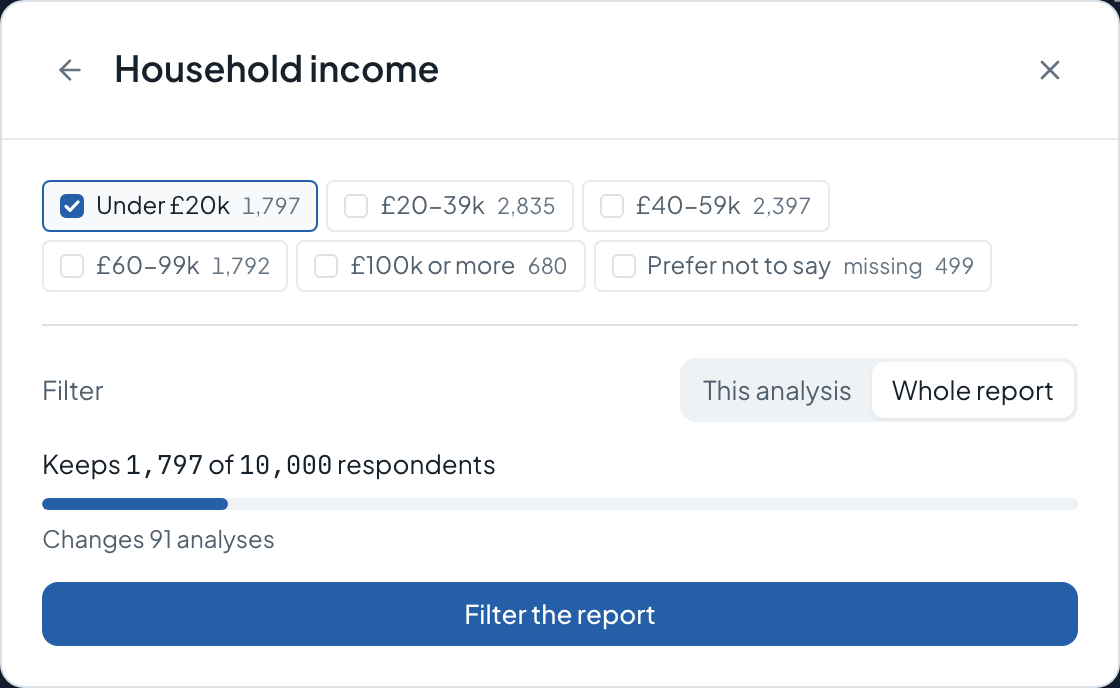
The consequence before the change. When you change whom a report counts, Velocity shows what the change would do before it is made: a bar of how many respondents it keeps, and how many analyses it changes. If the cut leaves fewer people than the project's small-base limit, the bar and the line say so in a warning colour. You find out before you apply it, not when the deck is checked.
A measure you can see before you save it. A measure is written as a sentence, such as the share who would seriously consider a brand among those aware of it. Before it is saved, the editor shows the figure, the base, the people left outside the base, and bars for every brand. If the base is not the one you meant, you see that at once and change the sentence.
A way back. Edits to a question's answers and changes to a report can be undone and redone. That is what makes it reasonable to try the second cut, the other base or the different chart.
The point of each is the same. A decision that would have been a rebuild is something you can answer by looking.
#What the tool should leave to you
An environment for thinking is not a replacement for it. Velocity drafts a headline that states the finding, and it cannot know whether the finding matters to your client. It marks a base as small, and it cannot decide whether 33 customers deserve a sentence. It can test a stated no-difference model under declared assumptions; deciding whether the size of a difference matters belongs to the researcher.
Those stay with the researcher. What the software can do is keep the repeated work out of the way, show what each choice does, and make the next look cheap.
Sources
- David Kirsh and Paul Maglio, "On Distinguishing Epistemic from Pragmatic Action", Cognitive Science 18(4), 1994, 513–549.
- Ben Shneiderman, "Direct Manipulation: A Step Beyond Programming Languages", IEEE Computer 16(8), 1983, 57–69, doi:10.1109/MC.1983.1654471.